Loot Boxes and Gacha Mechanics: How Video Games Learned to Sell Gambling to Kids
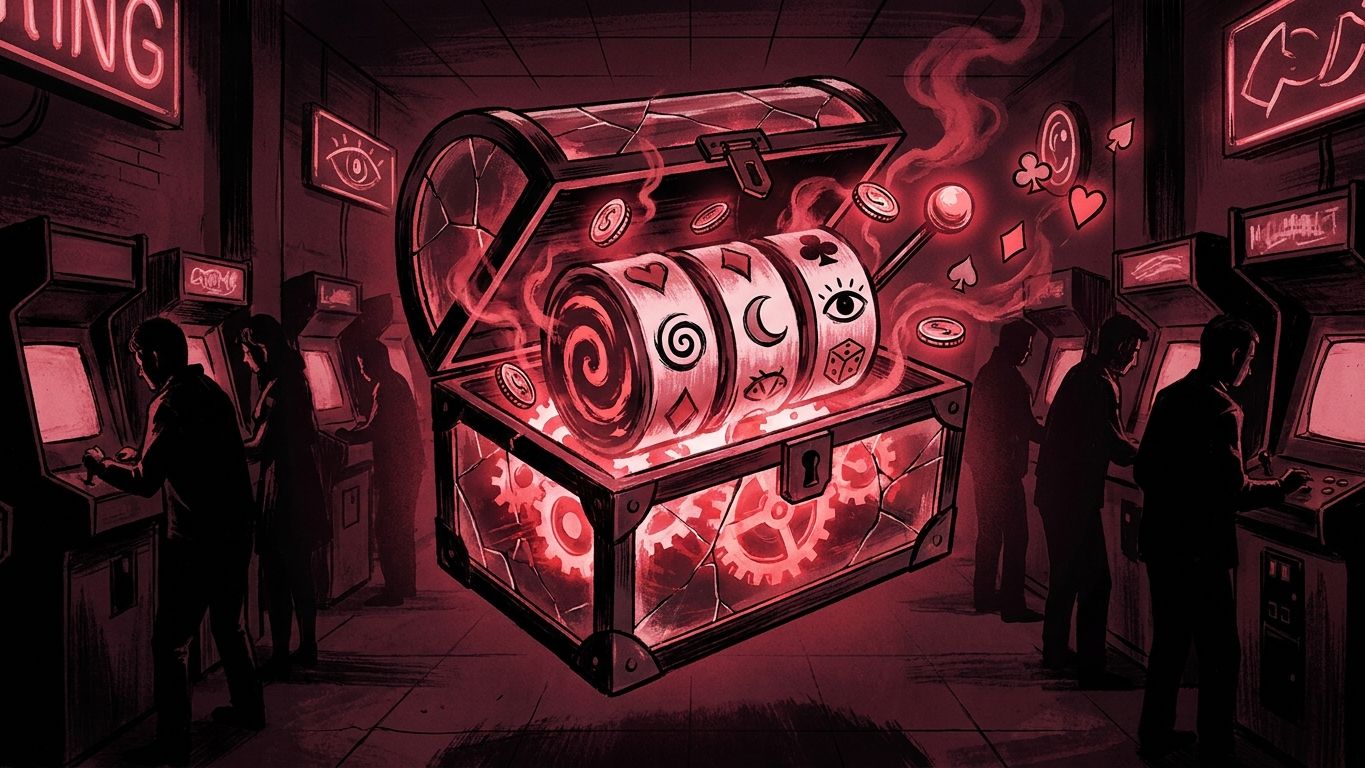
You spend real money. You get a randomized result. A small, deliberately engineered chance of something rare keeps you coming back for another pull. Strip away the character sprites and the confetti animation, and a loot box is a slot machine wearing a video game's skin — one that a nine-year-old can buy with a parent's saved card details, three taps deep in a free app.
A Slot Machine Wearing a Game's Skin
A loot box is a purchasable, randomized bundle of in-game items — characters, weapons, cosmetic skins, currency — where the player doesn't know what they're getting until after they pay. Gacha games, named after Japanese capsule-toy vending machines, build their entire economy around this single mechanic: you spend real currency to "pull" for a randomized character or item, with the rarest and most powerful results deliberately set at the lowest odds. The structure is functionally identical to a slot machine — a wager, a randomized outcome, a payout schedule tuned by the house — except the payout is a cartoon sword, and the operator calls it a game rather than a casino.
Variable Rewards: The Same Trick That Runs Casinos
Behavioral psychology has a name for why this works so well: variable ratio reinforcement, the same schedule B.F. Skinner found produced the most persistent, hardest-to-extinguish behavior in his pigeons. A reward that arrives every time you pay for it is satisfying, but a reward that arrives unpredictably — sometimes on the first pull, sometimes on the fiftieth — is what keeps a behavior running long after it stops being fun. Slot machines are engineered around this exact schedule. So are loot boxes, gacha pulls, and the mystery-egg mechanics built into games marketed directly to children.
The game doesn't need you to enjoy the item you win. It needs you to remember the one time you almost won something better.
The Near-Miss That Keeps You Pulling
Gambling researchers have documented a specific quirk of the human brain called the near-miss effect: a loss that looks almost like a win — two matching symbols and a third just one position off, a pull that lands on the second-rarest tier instead of the rarest — activates the same reward circuitry as an actual win, even though nothing was gained. Many loot box systems are tuned to manufacture exactly this experience, surfacing "so close" outcomes far more often than pure chance would produce, because a near-miss doesn't feel like a reason to stop. It feels like a reason to try once more.
Whales, FOMO, and the Business Model Behind the Odds
Free-to-play economics run on a small fraction of players — industry insiders call them whales — who account for a disproportionate share of total revenue, often reported to be a large majority of it from well under one in twenty paying users. Loot box systems are tuned to court exactly this behavior: limited-time banners that promise better odds for 48 hours, pity systems that guarantee a rare item after enough failed pulls but only if you keep spending until you hit the counter, and rotating character releases designed to make last month's best pull feel obsolete. None of this is incidental. The odds, the timers, and the pity thresholds are product decisions, tested and tuned the same way a casino tunes a slot floor.
The Design Tricks Inside the Box
- Pity timers guarantee a rare drop after a fixed number of pulls — a floor that only pays off if you keep buying until you reach it
- Limited-time banners frame a character or item as available for 48 or 72 hours only, manufacturing urgency around a purely digital, infinitely reproducible asset
- Sunk-cost currencies sell in bundles that never quite match a pull's price, leaving a small leftover balance that nudges you to buy more rather than let it sit unused
- Undisclosed or obscured odds bury drop rates in a settings submenu, if they're published at all, making the true cost of a guaranteed item nearly impossible to calculate upfront
- Secondary skin markets let randomized in-game items be cashed out for real money on third-party sites, turning some loot box systems into unlicensed gambling in every sense but name
Is It Gambling? Regulators Still Can't Agree
Belgium and the Netherlands have both ruled that certain loot box implementations meet their legal definition of gambling, forcing changes or outright removal in those markets. Several other countries now require published drop-rate disclosures, and some jurisdictions have floated age restrictions or purchase caps for randomized in-game monetization aimed at minors. But there is no unified global standard, and most major markets — including the US at the federal level — still treat loot boxes as a game feature rather than a regulated wager. That gap is precisely why the mechanic has survived: it can be redesigned around a specific country's rules without changing its underlying psychology anywhere else.
What to Watch For
- Check whether a game publishes drop rates before you spend — if the odds are hidden, treat that as the answer to how good they are
- Set a hard monthly cap before opening a single pack, and stop when you hit it regardless of how close a pity counter looks
- Turn off saved payment methods on any device a child uses — the three-tap purchase flow is the product, not an accident
- Treat a "limited-time" banner as a pressure tactic, not real scarcity — next month's banner sells a different character using the exact same urgency
Loot boxes survive because they don't look like what they are. A slot machine announces itself the moment you walk up to it; a gacha banner just looks like the next chapter of a game you already enjoy. The mechanics underneath — the variable payout, the near-miss, the countdown timer — are the same ones a casino floor is built on. The difference is that no one has to check an ID at the door.